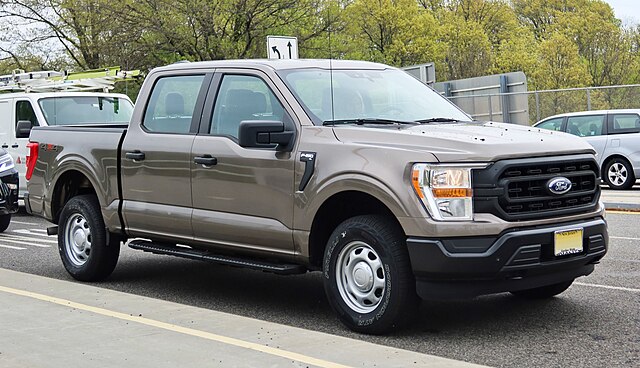
Low-cost EV truck goal
Ford's low-cost EV truck project is framed around a roughly USD 30,000 pickup with a targeted 2027 launch and around 300 miles of range. The product target is aggressive, but the manufacturing target is the deeper story.
The project reportedly uses a small team outside normal corporate routines and focuses on simplified parts and an assembly-tree concept rather than a traditional line-by-line rework of existing methods.
For U.S. automakers, the lesson is that low-cost EV competition is not solved by battery sourcing alone. It requires a rethink of vehicle architecture, plant flow, electronics packaging, and the number of build steps per unit.
Assembly process rethink
The reported price point is striking because Ford is not trying to create another premium electric truck. The F-150 Lightning proved that a full-size EV pickup can deliver performance and utility, but it also exposed the cost challenge of electrifying a large truck with a large battery. A smaller, lower-cost pickup forces a different engineering question: how much truck utility can be preserved if every kilogram, module, wire, and assembly step is challenged from the beginning?
That is where the manufacturing architecture becomes central. A modular assembly-tree approach suggests that Ford wants major subsystems to come together in parallel before final integration, rather than pushing every operation through a conventional moving line. If executed well, this can reduce work-in-process complexity, shorten build time, and let engineering teams simplify the product around manufacturing reality instead of adding fixes late in the program.
The project also appears to borrow from software and startup methods without abandoning Detroit's production knowledge. Small teams can iterate faster on cost, packaging, and user experience, but a retail pickup still has to survive durability cycles, corrosion tests, safety validation, dealer service, insurance scrutiny, and high-volume supplier readiness. The experiment will succeed only if speed and manufacturing discipline reinforce each other.
Competitive pressure from China
Battery cost remains the largest constraint. A 300-mile target in an affordable pickup requires efficiency, aerodynamics, low mass, and careful feature selection. The cheaper route is not simply installing a smaller battery; it is designing the whole vehicle so a smaller battery can still deliver acceptable range and performance. That includes thermal systems, tires, body structure, electronics power draw, and charging behavior.
Competitive pressure from China explains the urgency. Chinese EV makers and battery suppliers have shown that cost reduction comes from integration, supply-chain scale, and fast product cycles. Ford's challenge is to build a U.S.-market vehicle that can meet American safety, service, and customer expectations while approaching the cost logic of newer EV-native competitors.
The Louisville production preparation will be the real test. A concept team can prove a bill of materials and a prototype process, but a plant must repeat it thousands of times with stable quality. If Ford can translate the experiment into a profitable, high-volume vehicle, the low-cost truck program could influence far more than one model. It could become a template for how legacy automakers redesign manufacturing around affordable EVs.
Source and editorial note
This AutoIntel Lab brief is an original rewritten analysis based on Wall Street Journal. It summarizes market implications and does not reproduce the source article body.